
Question 1
What does IndexOf() from the Child class have direct access to?
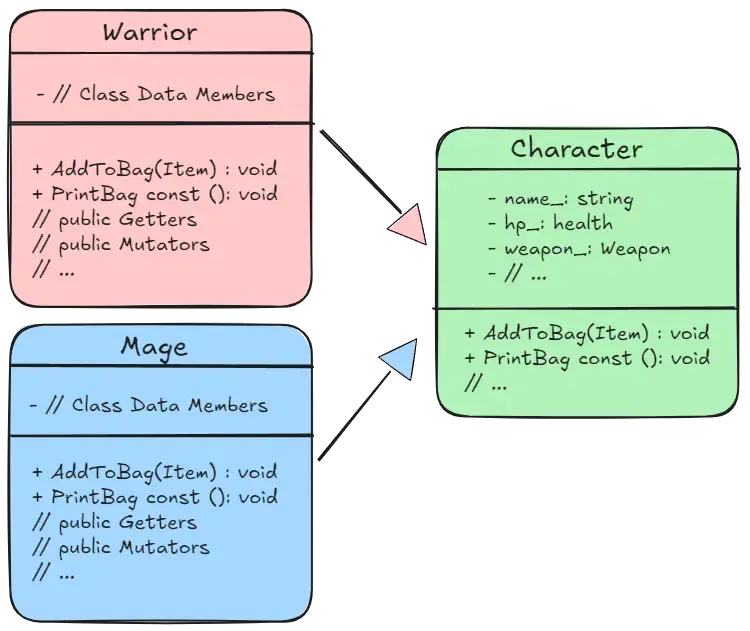
Inheritance establishes an “is-a” relationship, where a derived class “is a”
specialized form of the base class. For example, a Warrior class is a
specialized form of a Character class in a game, adding or overriding features
(e.g., unique weapons) while retaining everything common to all characters.
Key Terms
Base (Parent) Class: The existing class whose members are inherited.
Derived (Child) Class: The specialized class that inherits from the base class.
Code Reuse: You don’t have to rewrite every piece of logic that already exists in the base class.
Extend Functionality: You can add new attributes or methods—or override existing ones—without modifying the original class.
Maintainability: Changes to common features can be made in the base class, automatically affecting all derived classes.
When you define a derived class, you specify which base class it inherits from,
along with the inheritance type (e.g., public, protected, or private). A
common pattern is:
#include "parent.h"
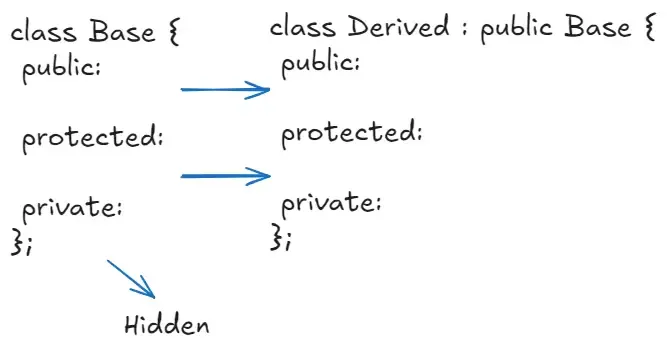
class ChildClass : public ParentClass { // State and Behavior};Public Inheritance (class Derived : public Base)
Public members of Base remain public in Derived.
Protected members of Base remain protected in Derived.
Private members of Base are not accessible by Derived
(unless via friend or member functions).
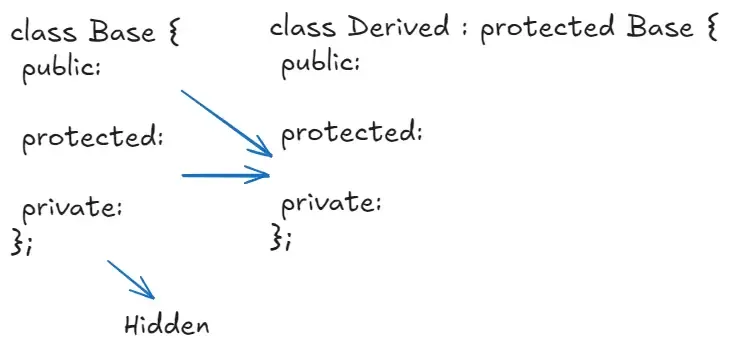
Protected Inheritance (class Derived : protected Base)
Public and protected members of Base become protected in Derived.
Private members of Base are still inaccessible.
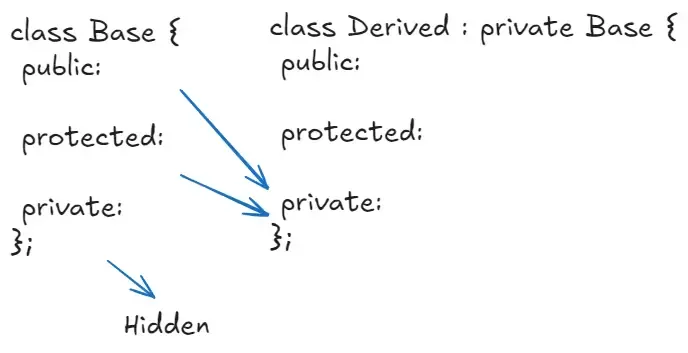
Private Inheritance (class Derived : private Base)
Public and protected members of Base become private in Derived.
Private members of Base are still inaccessible.
The following is an example of a UML Diagram that you may be asked to identify during an exam. The key detail to remember is that you have a straight lined arrow pointing to the parent class:
Here are some exercises to help you understand how access specifiers work in inheritance. These exercises are very similar to problems you may find in an exam.
These problems contain a single parent and child class.
The Parent class is publicly inherited by the Child class in this scenario:
class Parent { public: void Print() const; protected: bool Contains(int) const; private: int x_;};class Child : public Parent { public: void GetY() const; protected: int IndexOf(int) const; private: int y_;};Question 1
What does IndexOf() from the Child class have direct access to?
Question 2
What does an object of the Child class have direct access to?
Answer 1
Parent: everything except int x_
Child: everything
Answer 2
Parent: Print()
Child: GetY()
The Parent class is inherited by the Child class using protected inheritance:
class Parent { public: void Print() const; protected: bool Contains(int) const; private: int x_;};class Child : protected Parent { public: void GetY() const; protected: int IndexOf(int) const; private: int y_;};Question 1
What does IndexOf() from the Child class have direct access to?
Question 2
What does an object of the Child class have direct access to?
Answer 1
Parent: everything except int x_
Child: everything
Answer 2
Parent: nothing
Child: GetY()
The Parent class is privately inherited by the Child class in this scenario:
class Parent { public: void Print() const; protected: bool Contains(int) const; private: int x_;};class Child : private Parent { public: void GetY() const; protected: int IndexOf(int) const; private: int y_;};Question 1
What does IndexOf() from the Child class have direct access to?
Question 2
What does an object of the Child class have direct access to?
Answer 1
Parent: everything except int x_
Child: everything
Answer 2
Parent: nothing
Child: GetY()
These exercises use a parent class called A1, a child class called A2, and a grandchild class called
A3.
In this scenario, the A2 class inherits the A1 class publicly, and the A3 class
inherits the A2 class publicly:
class A1 { public: void Print() const; protected: bool Contains(int) const; private: int x_;};class A2 : public A1 { public: void GetY() const; protected: int IndexOf(int) const; private: int y_;};class A3 : public A2 { public: void GetZ() const; protected: void Swap(int); private: int z_;};Question 1
What does Swap() from the A3 class have direct access to?
Question 2
What does an object of class A3 have direct access to?
Answer 1
A1: everything except int x_
A2: everything except int y_
A3: everything
Answer 2
A1: Print()
A2: GetY()
A3: GetZ()
In this scenario, the A2 class inherits the A1 class with a protected accessor, and the A3 class
inherits the A2 class publicly:
class A1 { public: void Print() const; protected: bool Contains(int) const; private: int x_;};class A2 : protected A1 { public: void GetY() const; protected: int IndexOf(int) const; private: int y_;};class A3 : public A2 { public: void GetZ() const; protected: void Swap(int); private: int z_;};Question 1
What does Swap() from the A3 class have direct access to?
Question 2
What does an object of class A3 have direct access to?
Answer 1
A1: everything except int x_
A2: everything except int y_
A3: everything
Answer 2
A1: nothing
A2: GetY()
A3: GetZ()
In this scenario, the A2 class inherits the A1 class privately, and the A3 class
inherits the A2 class publicly:
class A1 { public: void Print() const; protected: bool Contains(int) const; private: int x_;};class A2 : protected A1 { public: void GetY() const; protected: int IndexOf(int) const; private: int y_;};class A3 : public A2 { public: void GetZ() const; protected: void Swap(int); private: int z_;};Question 1
What does Swap() from the A3 class have direct access to?
Question 2
What does an object of class A3 have direct access to?
Answer 1
A1: nothing
A2: everything except int y_
A3: everything
Answer 2
A1: nothing
A2: GetY()
A3: GetZ()
When you instantiate an object of a derived class, the base class constructor is called first, followed by the derived class constructor. This ensures that all inherited data members and functionality are properly initialized before the derived class adds or modifies anything.
You can control how the base class constructor is called by explicitly invoking it in the member initializer list of the derived class constructor. For example:
class Derived : public Base { public: Derived() : Base() { // Constructor Body }};In this snippet, Derived() calls the base constructor Base() in its initializer list
before executing its own constructor body.
If you omit this call, the compiler will look for a default constructor in the base class—or fail to compile if no suitable constructor exists.
The base class constructor runs first, initializing everything inherited.
The derived class constructor runs next, completing any additional setup for the derived class.
In C++, if a derived class redefines (or shadows) a non-virtual function from the base class using the same signature, the compiler binds to that function at compile time (also known as static binding). This is different from overloading, where functions in the same scope have distinct signatures (e.g., different parameter types or counts).
class Base { public:  void Show();};
class Derived : public Base { public:  // Redefines the Show function  void Show();
// Explicitly call the Base version void CallOldShow() { Base::Show(); }};Compile-Time Binding: Since the function is non-virtual (which will be covered in Polymorphism), the base or derived version is chosen at compile time based on the variable’s declared type.
Different from Overloading: Overloading requires different signatures, whereas redefining retains the same signature as the base class.
Calling the Base Version: To invoke the base class implementation from within the derived class, use the scope resolution operator:
BaseClassName::FunctionName(arguments);Multiple inheritance allows a child class to be derived from two or more base classes. While you probably won’t use multiple inheritance in your assignments, it is a concept you might encounter on an exam.
In C++, multiple inheritance is when a class inherits from two or more base classes:
class Base1 { public:  void Function:();};
class Base2 { public:  void AnotherFunc();};
class Derived : public Base1, public Base2 { public: void MoreFunc();}Ambiguity: If two base classes share a common ancestor, the derived class may inherit multiple versions of the same member, causing ambiguity.
Name Conflicts: If two base classes have members (e.g., functions) with the same name, the derived class must explicitly specify which version to use.
Use When: The base classes represent independent behaviors that don’t overlap.
Do Not Use When: The base classes share significant overlap or are tightly coupled, as this leads to unnecessary complexity and ambiguity. In such cases, consider using composition or a single inheritance hierarchy instead.